

What's The Average Lifespan Of A Refrigerator Water Filter?
The very first fridge was just a simple wooden box containing ice and salt. By today's standards, it was remarkably primitive (though some might argue that old-school refrigerators were actually more reliable, and that they had features that were way more functional than today's models). However, ever since their humble beginnings, fridges have come a long way. They now come equipped with features nobody could have imagined back in the day, whether door alarms, advanced air filtration systems, or even Wi-Fi settings. Water filters are another feature many homeowners find useful. But just like any other filter, they don't last forever, which brings us to the question: how long do refrigerator water filters typically last?
In most cases, you'd expect your fridge's water filter to last about half a year. That's mostly equivalent to filtering about 200 to 300 gallons of water (though some may be able to filter up to 500 gallons) before it should be replaced. Still, its actual lifespan depends on several factors, including your household's water usage, the quality of your tap water, as well as the type and brand of filter you're using.
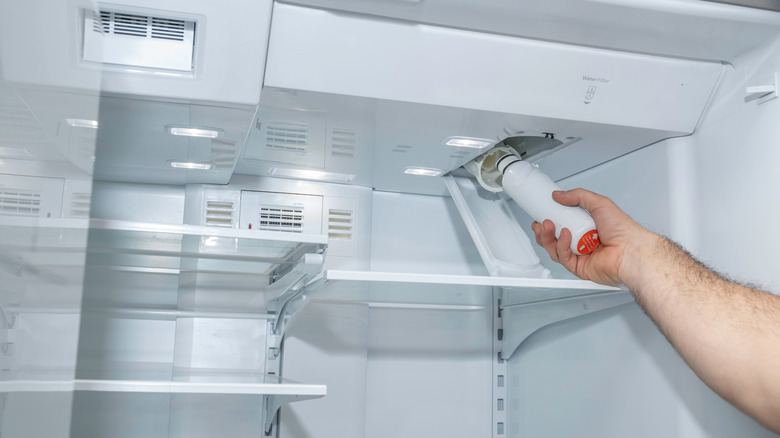
To understand why some filters wear out faster than others, it's worth taking a closer look at how they remove contaminants. A water filter is a removable cartridge installed inside the fridge. Its purpose is to clean the water used for drinking and making ice. Most filters rely on activated carbon along with a fine sediment screen to trap rust, dirt and other particles. They additionally reduce much of the chlorine that's used to disinfect the drinking water. But frequent use and poor water quality can shorten how long the filter can effectively do these things, meaning you'd likely have to replace it sooner than the manufacturer suggested.
Delaying the replacement can lead to bigger problems
Most modern refrigerators have an indicator light that alerts you when the time has come to replace the filter. Failing to install a new one, or even intentionally putting the change off, can actually lead to many other unexpected issues and affect your fridge's performance. As the activated carbon inside the filter becomes spent or fouled, it loses the ability to remove chlorine and contaminants. In turn, the contaminants can build up inside the filter and clog it. This can subsequently limit water flow and make the filter less effective.
With that in mind, even if your refrigerator doesn't have a replacement indicator, there are clear signs that the filter may have reached the end of its lifespan. Spent carbon samples often contain bacteria, greasy buildup, and rust deposits. Because of this, your water may develop an unusual taste or odor, appear cloudy, dispense slower than usual, or even produce smaller ice cubes. So, think of replacing your filter as an investment to keep your ice tasting fresh.
Replacing your fridge's water filter is no rocket science. Though if you're unsure about how it works, it might be wise to call a professional. Once you install a new one, however, it's crucial not to forget to flush up to four gallons of water through the dispenser before you start drinking any of it. This is how you'll get rid of trapped air, residual carbon particles, cloudiness, and make sure that your water is safe and clean.