

All You Need To Give Plain Rice More Flavor Is This Vegetable Hiding In Your Pantry
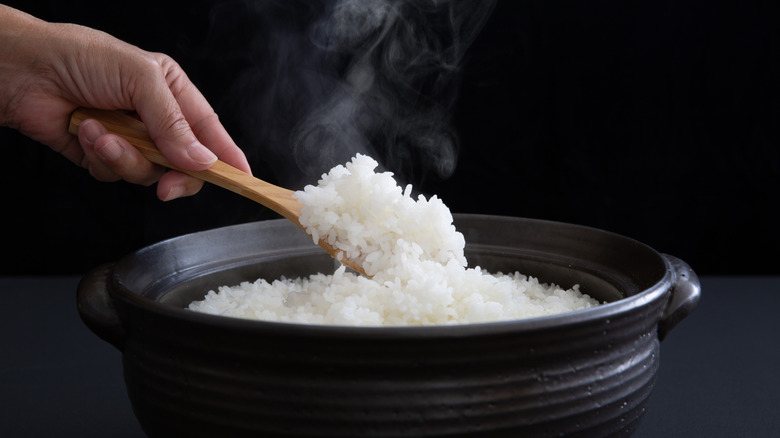
When it comes to the most versatile ingredients for meal prepping, a surprising powerhouse is basic stovetop steamed white rice. It's the perfect foundation for grilled salmon or roasted chicken thighs, a comforting base for burrito bowls or Chinese beef and broccoli, and offers a great way to bulk up soups and stews to stretch them slightly further. In fact, the only downside to rice is also an advantage: It's a bit bland on its own, but that makes it all the easier to elevate with other simple pantry staples, like onions.
Onions are a vastly underrated aromatic and flavoring element, one that most of us take for granted. However, there's something about sauteing an onion on its own that makes a kitchen smell like home. The same goes for when you use it as a seasoning in starches like rice. It won't necessarily taste strongly of onion, but this root veggie's sweet, earthy astringence will add that extra pop of "something" that makes rice the star of the dish.
Most advantageously, upgrading rice with delicious onion-y umami is very simple. All you have to do is chop up the onion (size and shape is up to you), saute it in the bottom of your cooking pot for a few minutes, and then add your cooking liquid and rice. That initial kiss of heat releases the onions' flavor and lightly caramelizes them, providing lots of deliciousness for the rice to absorb as it softens, steams, and becomes beautifully fluffy.
Any way you slice it: tapping into your onion's superpowers
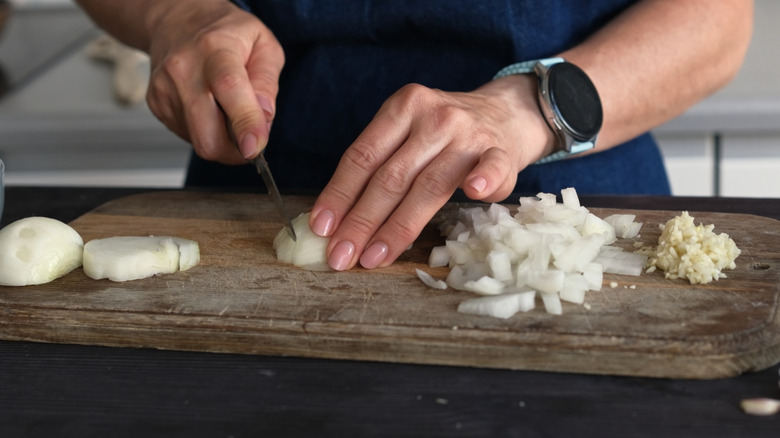
One really cool fact about onions is that the right cutting technique can strengthen or soften their zippy, pungent flavor, depending on your preferences. Slicing an onion open releases specific compounds responsible for producing their signature aroma and flavor, along with the famous vapors that sting your eyes and make you cry. Cutting large, wide slices of onion with the grain (parallel to the striations along the onion's surface) releases fewer of these compounds, while mincing small pieces against the grain (perpendicular to the striations) releases lots of them.
This means that if you want a mild, soft onion flavor in your rice, you should stick to strips or larger pieces of onion. While bigger pieces might interfere with the rice's texture, the onion will soften quite a bit while the rice simmers. At the end of the cooking process, you should be able to gently mash the larger onion pieces down and stir them through the rice to hide their texture.
Meanwhile, if you want to add lots of big flavor to your white rice, you should mince your onion into small pieces to release the maximum amount of onion-y goodness. You could also grate it to release more of the juices and make the onion taste deeply pungent. Smaller pieces will also need less time to saute to become transparent and lightly sweet, so be prepared to add your rice and liquid quickly once the onion is ready.