

How To Cook Steak In An Oven Like A Pro
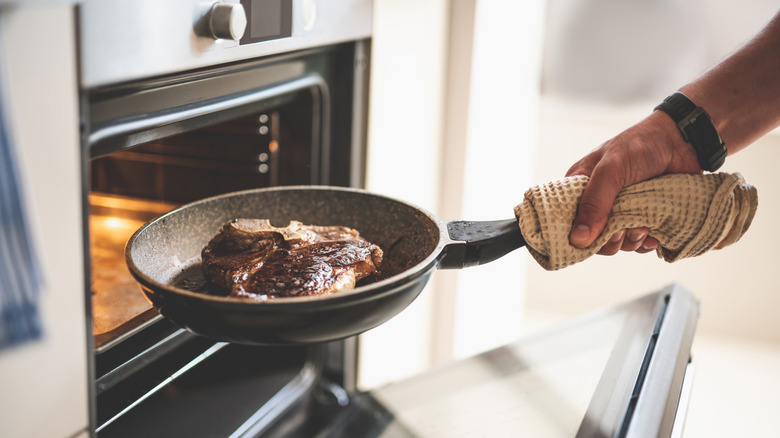
Steaks are usually cooked on stovetops, with people preferring a cast iron pan for a good sear. The oven is an underrated option, but it has its advantages, especially if you like a fine crust — and it's pretty simple to do. Chowhound exclusively spoke with Ashley Lonsdale, chef-in-residence at ButcherBox, who shared all the tricks up her sleeve when cooking steak in an oven, and what makes the method an appealing choice.
For one, Lonsdale mentions thicker cuts are essential. "Thicker cuts of steak (1.5 inches and beyond) take longer to cook through than thinner cuts, so the oven is a great tool for gently cooking the interior without overcooking the steak," she explained, but added that "Searing is still an essential step for getting a savory, satisfying crust on your steak, and you can do it either before or after."
Lonsdale further adds that "The best way to cook steak before searing (as in the reverse-sear method) is in a low-temperature oven — between 300 and 350 degrees Fahrenheit — to give you a broad window of time to hit your desired internal temperature." This process also gives you an interior that's uniformly cooked since the heat rises gradually, which can be tricky with the stovetop method. What's more, the low temperature and gentle heat means that overcooking is rarely a problem. However, you have to know more than that to cook steak in an oven like a pro.
Tips to guarantee a successful steak with oven-cooking
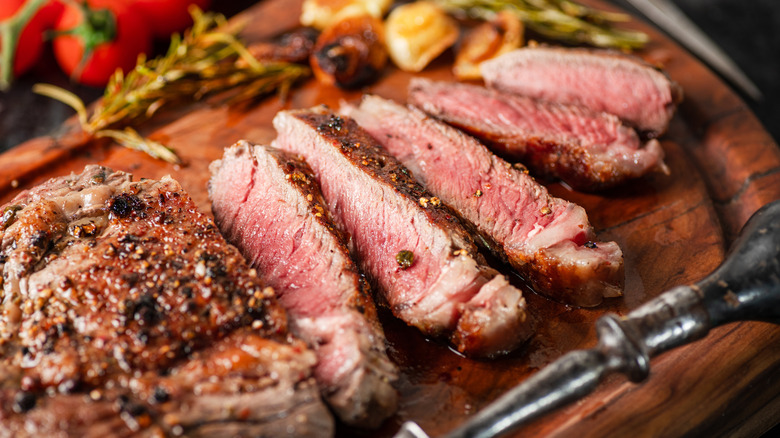
Before you start testing out the tricks Ashley Lonsdale shared, there are some important aspects to consider if you want to cook steak in an oven successfully. "I choose grass-fed steaks for deep beefy flavor, but they do cook faster, so it's crucial to lower the internal temperature targets by 5 to 10 degrees." Grass-fed beef, which can turn some shoppers away because of how gamey it can be, cooks faster because it contains less fat, making it easier for heat to penetrate the meat. This is why, as Lonsdale says, "Richer cuts like ribeye with more fatty tissue will cook more slowly than leaner cuts like filet mignon." Alternatively, you can check food doneness in a lot of ways, including utilizing a meat thermometer.
If you're still on the fence, there's nothing wrong with indulging in trial and error, and you can use it as an excuse to eat as much steak as you want. "Cooking a great steak takes attention, care, and PRACTICE [sic]. My advice would be to choose one technique and stick with it," Lonsdale advises. However, if you want guaranteed success, searing the steak as the final step is ideal. "Reverse searing has a slightly wider margin of error, so if you're stuck between the two, try searing after for extra confidence."