

What Is The Right Fridge Temperature To Keep Meat At Optimal Freshness?
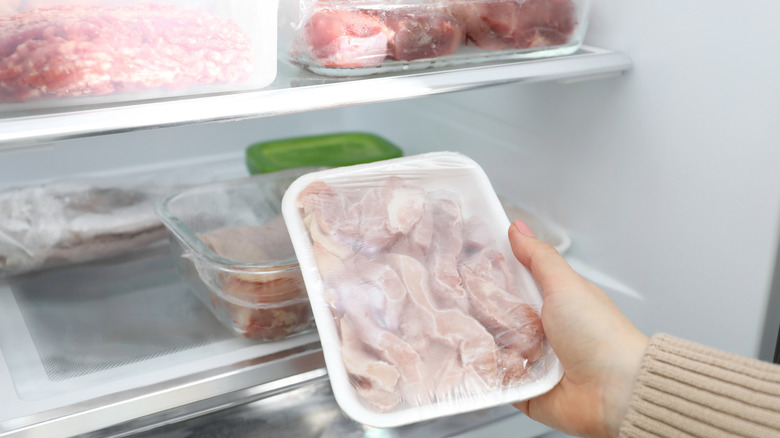
When it comes to avoiding common food safety mistakes for handling raw meat, the most important thing is ensuring your proteins remain at the right temperature. In fact, this goal is the root of most meat-based food safety rules, from understanding how long it takes to defrost meat in the refrigerator, to knowing where to place it inside your fridge to protect it from temperature fluctuations when you open the door. Of course, all these efforts are moot if your fridge isn't set to the proper temperature to keep everything fresh in the first place.
Ideally, your fridge should be set between 32 and 40 degrees Fahrenheit to ensure your meat doesn't spoil prematurely, with the perfect stable temperature sitting at about 37 degrees Fahrenheit. According to the U.S. Department of Agriculture, this range of temperatures helps significantly slow microbial growth, keeping your meat fresh and safe to eat for up to two days in most cases, with raw steak and other red meat lasting up to five days. Temperatures above 41 degrees Fahrenheit aren't cold enough to stave off the development of foodborne pathogens, while temperatures below 32 degrees can partially freeze the food inside your fridge. To ensure your fridge is always at optimum temperatures, it's recommended to keep an appliance thermometer inside if your fridge doesn't have one built in.
Adjusting your fridge's temperature and where to place your proteins
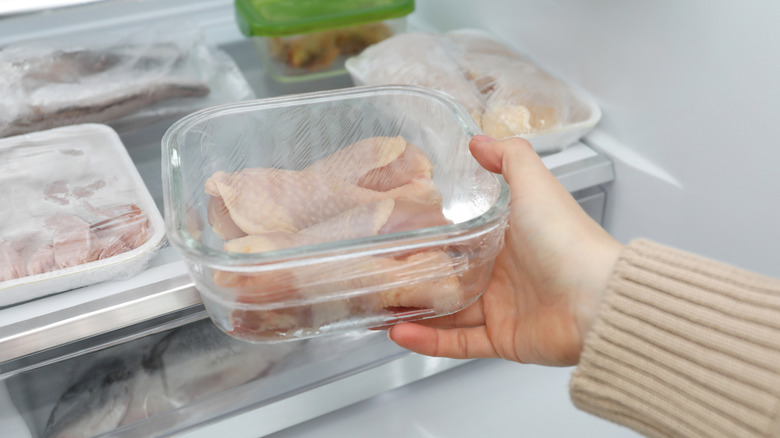
To know whether your fridge is at the right temperature to keep your raw proteins from spoiling, center one appliance thermometer at the back of the top shelf and one at the front of the bottom shelf, to monitor that the temperature remains even throughout your appliance. Neither thermometer should ever read below 32 degrees Fahrenheit or rise above 40 degrees. Ideally, both sit between 35 and 38 degrees.
If the temperature inside your fridge needs to be adjusted, you can either consult your owner's manual or your appliance brand's official website for instructions pertaining to your specific model. Digital displays can be adjusted to the precise temperature you want (about 37 degrees Fahrenheit), while dials labeled with numbers can be turned so the desired temperature is aligned with the indicator arrow next to the dial. If your refrigerator's dial reads "cold, colder, coldest," or is a series of numbers from 1 to 10, it's even more important to have a refrigerator thermometer to understand exactly which setting corresponds to the ideal temperature.
Even if your refrigerator is running at optimum temperatures 100% of the time, temperatures will still vary slightly from shelf to shelf with the door and top shelf being the warmest areas, and the back of the bottom shelf being the coldest. Another common storage mistake that is ruining your food is storing raw meat on the top shelf of your fridge, as it will spoil more quickly. Instead, place raw proteins on the bottom shelf until you're ready to use them, storing cooked leftovers safely on the top shelf.