

For The Best Fried Fish, Reach For This Type Of Oil
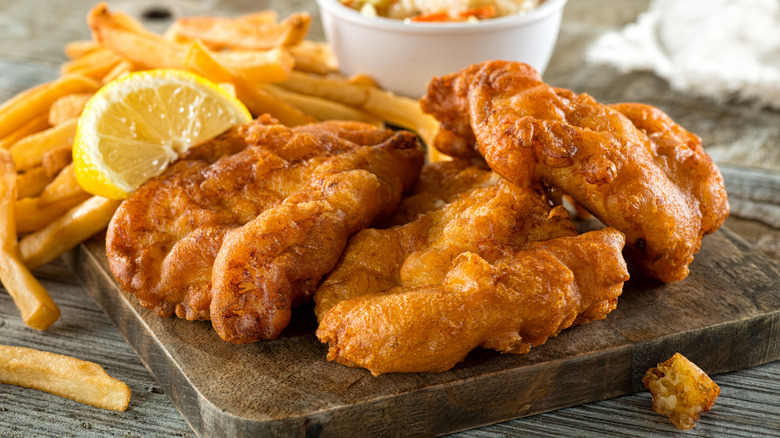
Crunchy and golden-brown on the outside yet incredibly juicy and tender on the inside, fried fish is a go-to comfort food for many. It gets even better when served with french fries and tartar sauce on the side. But frying fish properly requires a certain level of skill. While letting the batter rest in the fridge overnight is an easy tip Gordon Ramsay uses for crispier fried fish, the type of oil you use can actually make or break the dish. For the best results, you'll want to use peanut oil.
In an exclusive conversation with Chowhound, Allie Hagerty, a food blogger and the recipe creator behind Seasoned & Salted, said that she swears by peanut oil for frying fish. "It has a smoke point around 450 degrees, a really clean neutral flavor that lets the fish actually taste like fish, and it produces a genuinely great crust," Hagerty pointed out. She elaborated that peanut oil shines even when you're making several other sides to serve with the fish, like hushpuppies, okra, or fries, all of which require frying. That's because peanut oil holds up well through multiple batches of frying. "It stays stable, maintains temperature well between batches, and does not transfer flavors from one thing to the next," Hagerty, who is also a second-generation fishmonger, added.
At the same time, Chip Carter, who produces and hosts the National TV, YouTube, and Classroom series "Where The Food Comes From," also expressed a strong preference for peanut oil when it comes to frying fish or anything else for that matter. "It does not impart its own flavor but it certainly enhances others. Nothing's going to give you crispy perfection like peanut oil," Carter told Chowhound.
The oil type is just one part of perfectly fried fish
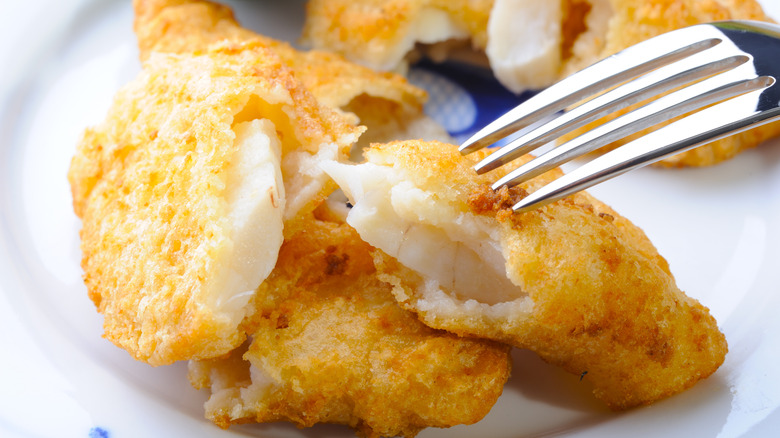
Ending up with soggy, greasy fish rather than the crispy perfection you were hoping for is probably every home cook's nightmare. But according to Allie Hagerty, the type of oil is rarely the reason fried fish could turn out this way. Most of the time, it's all about technique and the oil being too cold when the fish went in. This is one of the biggest mistakes to avoid when cooking fish.
"When your oil is at the right temperature, between 350 and 375 degrees Fahrenheit, the moisture on the surface of the fish evaporates immediately, and that is what creates the crispy crust," Hagerty stated. By contrast, cold oil causes the fish to absorb excess grease rather than develop a nice crust. Moreover, crowding the pan is yet another common mistake people make. "Too much fish at once drops the oil temperature fast, and you get the same soggy result," she said, and suggested using a thermometer to monitor the oil and prevent sudden temperature drops.
Chip Carter agreed that nailing the right oil temperature is the secret behind perfectly fried fish. He confirmed that oily fish is the result of underheated oil. "And if it was hot enough when you started, you didn't allow it time to recover between batches, or didn't monitor and let it cool off," he noted. Still, one of the greatest mistakes is heating the oil only to the desired frying temperature. Instead, the oil should be heated a few degrees higher than that point. This is because the temperature will drop a little the moment the fish is added to the pan.
The best peanut oil alternatives for frying fish
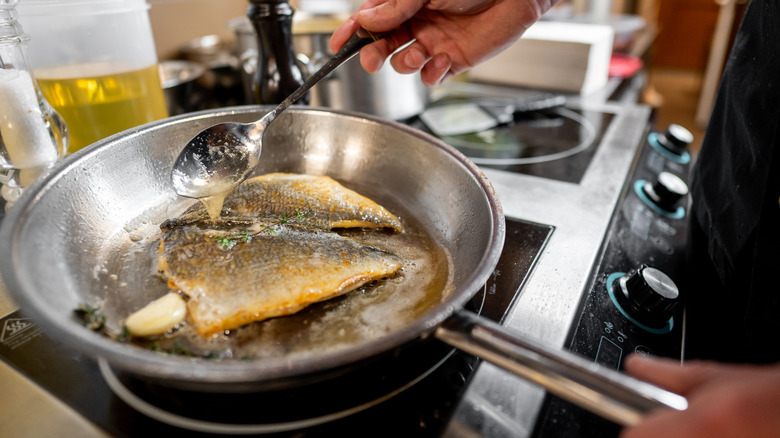
Peanut oil is the best choice for frying fish, and while you can swap it, it's best to do so with some care. You need to take the smoke point into consideration. Using oil with a lower smoke point is a great way to get your fish charred instead of crispy.
With that in mind, however, there are several alternatives you can use if you happen to run out of peanut oil. One surprisingly good option is canola oil. Allie Hagerty confirmed that canola oil is one of the best kinds of oils to use when you're deep frying fish. At the same time, she added that vegetable oil is acceptable as a backup option, but it tends to feel a bit heavier. "If peanut allergies are a concern, refined avocado oil is a great alternative with an even higher smoke point," Hagerty emphasized. As a matter of fact, refined avocado oil boasts one of the highest smoke points of any cooking oil, reaching up to 520 degrees Fahrenheit.
Meanwhile, cottonseed oil, due to its mild taste and high smoke point of 450 degrees Fahrenheit, is also considered an excellent choice for frying fish. Still, it isn't on Hagerty's priority list at all. "It is a high-smoke-point frying oil with a neutral flavor," she concluded. "But it is harder to find than other options, tends to be heavily processed, and honestly offers no real advantage over oils that are easier to get your hands on."