

Why Beef Meatballs In America Look So Different From Their Italian Roots
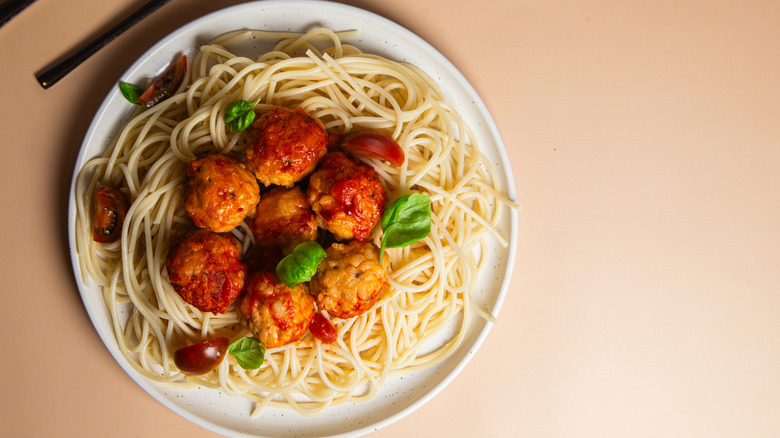
If you grew up eating at Italian restaurants in the United States, then of course you'd think that the combination of spaghetti and meatballs is one of the most quintessential Italian pairings there is. In reality, however, this is an "Italian" dish that isn't actually Italian. Italians do eat meatballs (which they call polpette), but they serve a totally different function in the meal.
In Italy, meals have a very specific structure in which pasta and meat are served separately, not together. Sure, some pasta dishes may contain small amounts of cured or finely chopped meat within the sauce, such as in carbonara or amatriciana, but what you will never see in Italy is a large portion of meat sitting on top of pasta. Not like in American spaghetti and meatballs or chicken alfredo. Instead, it is always served as a primo (first course) and then meat is served as the secondo (second course). Italians have a very clear meal system, and those curious can read our cheat sheet guide to Italian food courses for an overview of how it works.
In Italy, polpette are served on their own as a small secondo or as an appetizer (antipasto), sometimes with sauce or vegetables, but never with pasta. And they are usually smaller than the American versions too — in some regions of Italy, they are the size of marbles. They are also not strictly made from beef — depending on where you are and who is cooking, you may find polpette made with pork, veal, chicken, or even vegetables.
Immigration helped create the spaghetti and meatballs we know today
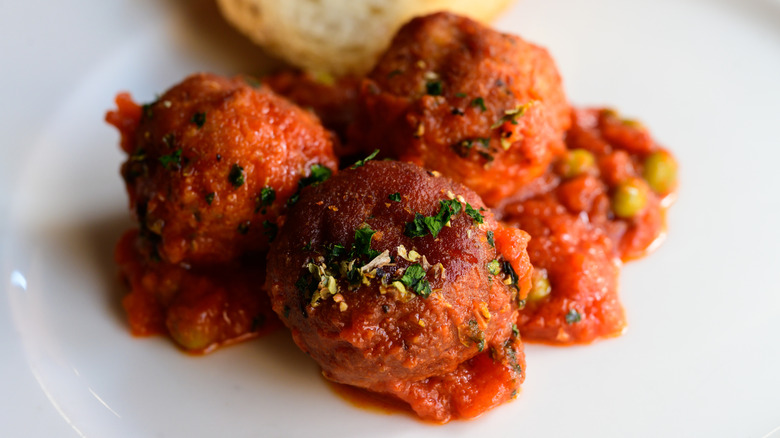
The way Americans today know meatballs is more of a love story between cultures than a lesson in the history of Italian food. When Italians arrived in the United States in the late 19th and early 20th centuries, they suddenly found themselves able to access much more meat than they could at home, so traditional dishes were adopted for new circumstances. Beef was more of a scarcity in Italy. In America, it could be integrated into much heartier meals, and so the meatballs themselves got bigger. Serving those large meatballs on top of pasta would have been much more appealing to American eaters who weren't used to Italy's multi-course meal system. Slowly, meatballs became synonymous with spaghetti in Italian-American cuisine, even though they're not prepared this way in Italy.
We often see this dynamic in other familiar menu items. For example, garlic bread may taste amazing in an Italian restaurant in America, but you won't find it in Italy, either. Italians do rub garlic onto bread whilst making bruschetta, but the buttered baguette that is served alongside a plate of pasta has no roots there. Similarly, people are sometimes surprised to learn that beloved "classics" like beef meatballs are creations of Italian-American restaurant culture and are not traditionally Italian at all.