

Do You Really Need To Dunk Boiled Eggs In Cold Water? What You Need To Know
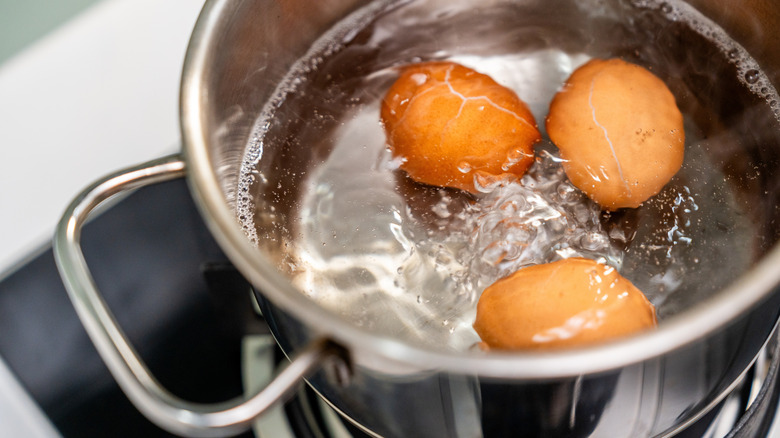
Chefs often share numerous methods for making perfect hard-boiled eggs, including the cooking process, timing, and whether you need to plunge boiled eggs into an ice bath. The answer really depends on your needs; however, there are benefits to cooling boiled eggs in cold water.
Eggs continue to cook when they are removed from the heat, so placing them in an ice bath for 15 minutes — known as shocking — prevents overcooking, which can cause the green color around the yolk to form. It's also one way to make hard-boiled eggs easier to peel, because shocking causes the egg whites to contract, pulling the thin membrane that surrounds the egg away from the shell. Shocking the egg is also said to prevent the formation of the common indent that usually occurs by allowing the space between the membrane and the egg to fill out completely, creating a more ideal shape. This is good if you want your eggs right away, but some cooks believe shocking can cause the shell to develop microcracks, which may allow bacteria in and reduce the amount of time they can be stored safely in the fridge.
There are more hard-boiled egg hacks you can use to effectively peel your eggs as well, including adding oil or vinegar to the boiling water. And some cooks skip boiling eggs altogether, making the case for steaming hard-boiled eggs instead to make easily peeled, perfectly tender eggs by allowing them to cool naturally.
Various ways to boil eggs with or without an ice bath

To make eggs with jammy yolks, place them in already boiling water to cook for eight minutes, then into an ice bath. This helps keep the yolks soft and spreadable, not runny, while making sure the egg white is set. Alternatively, soft-boiled eggs that have a set white, with yolks that are still runny, are best served warm and in the shell. In this case, cook the eggs in boiling water for less time, about six minutes, and remove without shocking them.
For hard-boiled eggs with firm yolks that don't utilize an ice bath, (and if you don't need them immediately), begin cooking them with cold water. Bring your pan of water with eggs up to a boil, then drop it to a simmer for about eight minutes. To cool, remove the pan from the heat, let it sit for 8 minutes, and then use cold tap water to cool the egg for serving. This produces a tender-yet-firm egg yolk.
Additionally, one of our tips that will improve the way you make hard-boiled eggs uses carryover heat. To cook, place eggs in water and remove your pan from the heat source when it reaches boiling. Cover it with a lid and let it sit for 10 to 12 minutes. You can choose to use the ice bath method or cold tap water to cool the eggs. But perhaps the best way to discover your favorite method for boiling an egg is to try different ways and see which works best for you.