

How To Make An Eco-Friendly Kitchen Floor Cleaning Solution With Ingredients You Already Own
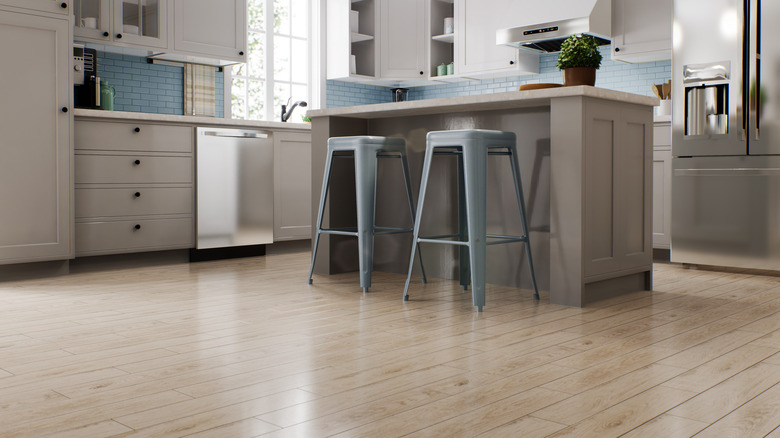
Sweeping your kitchen floor can be frustrating. Not only does it take a ridiculous amount of time, but no matter how often you do it, the floor never seems to be completely clean. It's even worse if it's made of natural stone tiles, which is hands down one of the worst kitchen floors you can choose and a nightmare to clean. Let's not even get started on those expensive cleaning products that never deliver the results they promise. And you might be surprised to learn that the secret to shiny floors is hiding in your kitchen pantry.
Jill Koch, creator of the online platform Jill Comes Clean, explained in an exclusive conversation that when it comes to cleaning floors, baking soda, castile soap, and vinegar are the most environmentally friendly substances to use. "Baking soda is mildly abrasive and great to sprinkle on floors before mopping for a little extra scrubbing power," Koch told Chowhound exclusively. "It can also help deodorize."
Meanwhile, castile soap, an olive or vegetable oil-based multi-purpose cleaner, works wonders when it comes to tackling dirty floors, grime, and germs. "Vinegar is a deodorizer and can sanitize," she explained further. "However, you don't want to use that on stone, tile, or wood floors." Koch added that lemon juice works just as well as vinegar, but both of those are better for linoleum.
Not all cleaning products can be mixed together safely
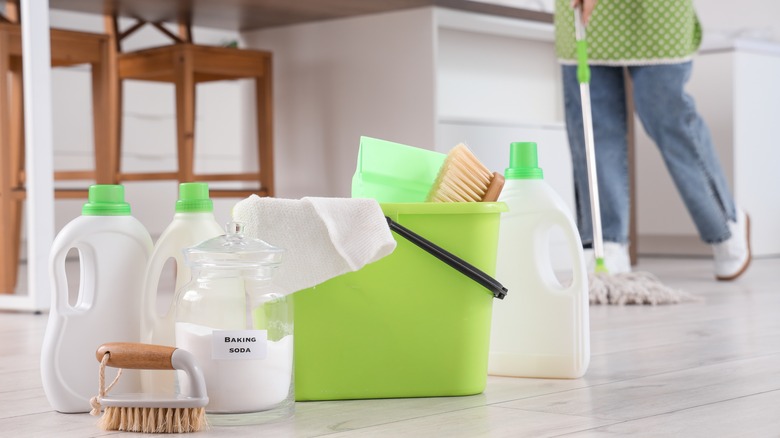
Certain combinations of cleaning products should be avoided because they can be potentially volatile. Jill Koch emphasized that bleach should never be mixed with anything. Bleach, whose active ingredient is sodium hypochlorite, is a powerful oxidizing agent. Even though it's widely used to destroy bacteria, viruses, and fungi, Koch warned that bleach can create harmful and dangerous fumes, which can irritate mucous membranes, skin, and airways. She added that she avoids mixing ammonia with other substances for the exact same reasons.
Koch also stated that, contrary to popular belief, baking soda and vinegar shouldn't be mixed either, as they simply cancel each other out. The reason for this is that baking soda is a base and vinegar is an acid. Once combined, they trigger a neutralization reaction that forms water and carbon dioxide. This basically means that once the fizzing stops, the mixture loses its cleaning power. "You can use them one after the other but don't combine them," she suggested. "Also, avoid peroxide and vinegar, as it can create peracetic acid, which is corrosive and irritating and can damage surfaces."
Different kitchen floors call for different DIY cleaning solutions

When making your own cleaning solution, it's important to adjust it based on the type of kitchen floor you have. "I just do soap and water for all floor types because you want to avoid anything too strong on wood, laminate, tile, and stone," Jill Koch revealed. "You also have to be careful about how much water you're using." While tile and stone can handle more moisture, too much water can damage wood and laminate and cause them to warp.
Similarly, harsh cleaners can take away a floor's natural shine. "So, for general cleaning, a little soap and warm water get it done," Koch pointed out. "Always opt for a mop that doesn't oversaturate and only puts out a thin layer of water that dries quickly." And if you don't have one at home, you can make your own mop by wrapping a towel around a broom. Have you ever heard of a better hack for cleaning your dirty kitchen floor?
If you prefer a store-bought cleaner rather than a homemade one, Koch suggested choosing an all-purpose cleaner, which should be labeled safe for stone, wood, laminate, or sealed surfaces. "Avoid anything labeled as acidic or for use on delicate surfaces," she concluded. "You could also look for labels that say things like biodegradable, nontoxic, or plant-based, as these are milder cleaning solutions."