

The Retro Ingredient That Was Once Illegal To Buy And Sell In Wisconsin

There are some pretty weird food laws that many people aren't aware of out there. And while food regulations often concern how we buy and sell certain goods, some municipalities and even entire states take things a bit far. Take, for instance, when selling uncovered ice cream cones was briefly banned in Carmel, California, in the 1980s until Clint Eastwood became mayor, or Louisiana making it illegal to place a delivery order for someone without their knowledge, according to a 2013 revision to its laws. There are even laws to ensure that the peanut butter you buy is (mostly) the real deal. Indeed, food laws can get peculiar, but one in Wisconsin was especially so. In 1895, a law banned the production and sale of yellow-dyed oleomargarine (which is the formal name of "margarine"). After a decades-long battle between butter and margarine producers, the law was mostly struck down, but some of it still remains to this day.
Originally, margarine was created as an affordable non-dairy butter substitute in France circa 1861. Not long after, margarine crossed over to the United States, where producers dyed it yellow from the original grayish white color and sometimes sold it as the real thing. As successful as the idea was, Wisconsin wanted to protect its highly valued dairy industry. Thus, after butter suppliers voiced their concerns about losing out on profits to margarine makers, state legislators created the Oleomargarine Act, making it illegal to make oleomargarine yellow. Other states either outright banned the product or required margarine to be dyed pink to visually mark it as "artificial" until 1898.
The Wisconsin Oleomargarine Act is repealed — mostly
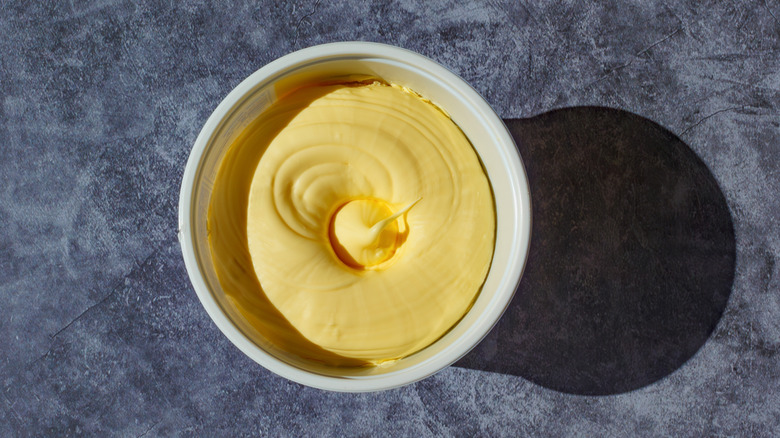
For context as to why Wisconsin dairy farmers felt threatened, there weren't any laws protecting local farmers from competing firms at the time. They were already battling the likes of swill milk (which is essentially a bluish, toxic milk produced by the cows of those larger dairy firms just looking to make a profit), so when a non-dairy alternative to butter came out, it added to existing industry pressure. While it may have been a harsh reaction, they responded by calling margarine a clear threat to society.
Despite the apparent war on oleomargarin, producers still managed to be successful. During the 1950s and 1960s, housewives would make "oleo runs" to purchase the more available and affordable margarine in Illinois, smuggling it across state lines. The battle between butter and the buttery spread waged until 1967, when the law was repealed. Today, while margarine can be produced in Wisconsin and sold in grocery stores, restaurant patrons must still request it, otherwise eateries can face fines and jail time. Meanwhile, state-funded institutions are outright banned from serving it to prisoners, patients, and students.
As intense as the so-called Oleo Wars became, whether butter or margarine is better is still debated since both come with benefits and risks. Butter could raise your cholesterol and is high in saturated fats, but it also provides essential nutrients like vitamin K2, which is a calcium regulator. Although margarine may be nutritionally superior to butter, even containing beneficial polyunsaturated fats, it can also have an abundance of trans fats, which can increase the risk of a heart attack. Just remember that there is a difference between butter and margarine, especially when cooking, and the latter isn't always a suitable substitute for real butter in some baking recipes.