

King Henry VIII Regularly Enjoyed This Medieval Version Of The Turducken
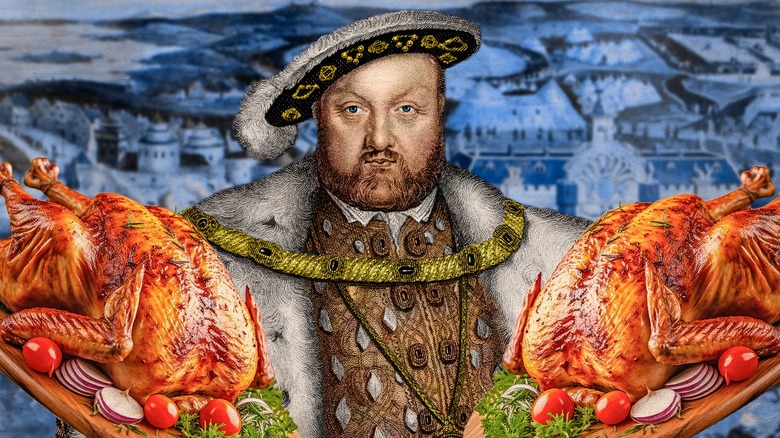
The second monarch of the Tudor dynasty brought about great change for his country. Under the reign of King Henry VIII, England saw thriving trade, arts, and culture, and even the establishment of a new state religion. Henry VIII is famous for this creation of the Church of England and infamous for his eventual six wives, but there isn't nearly enough talk of his extravagant taste in food.
A Tudor feast was luxurious, a sweeping buffet of fresh meats such as venison and swan, ale and wine, marzipan and fruitcake, and preserves and pies (but wrapped in pastry that probably wasn't for eating). The table would even feature beaver tails, porpoises, eels, and a medieval delicacy called cockentrice. You've likely heard of the turducken, an unhinged Thanksgiving staple that consists of a chicken stuffed inside a duck stuffed inside a turkey (collectively deboned), but the cockentrice predates this avian amalgamation by several centuries. While the turducken is, at least by name, probably a product of 1970s Louisiana, the cockentrice dates back to the 14th century. By the time Henry VIII ascended the throne in the early 16th century, feast tables would often include this striking dish of a pig sewn to a capon.
Combine a pig and a capon for a near-legendary entree
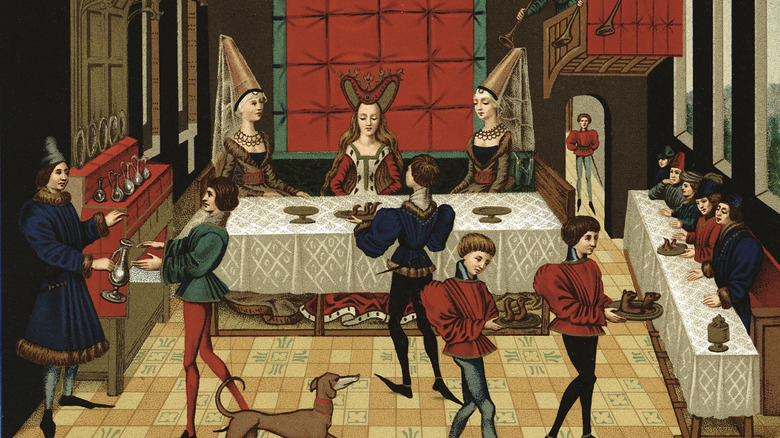
There's a mythical snake-chicken hybrid called a cockatrice; even though the similarly spelled cockentrice is more than just lore, the medieval dish does indeed look like something out of the Dungeons and Dragons Player's Handbook. The cockentrice is made by immersing a pig and a capon (a male chicken that was castrated as a way to make it taste better) in hot water, draining them, then cutting each animal in two. Ingredients such as bread, spices, and suet are stuffed inside before one half of each is taken and sewn to one half of the other — the front of the pig to the back of the capon, and vice versa. In case that presentation didn't hold enough theatricality to please the likes of Henry VIII, the cockentrice could be roasted on a spit or have its brandy-soaked head set on fire.
For some particularly elaborate medieval courts, cockentrice would be served with another unusual dish: coqz heaumez, or helmeted cock. In this staging, the roasted pig and chicken would be left intact, but the chicken would be artfully arranged on top of the pig as an armored rider. Although cockentrice was a more common menu item than its companion coqz heaumez, the Tudors and their contemporaries were clearly always game for a culinary show. For those with a little less of a stomach for Frankensteinian foods, you might have needed a swig of medieval vodka before you could clean your plate.