

Why Old Eggs Peel So Much More Easily Than Fresh Ones
We may receive a commission on purchases made from links.
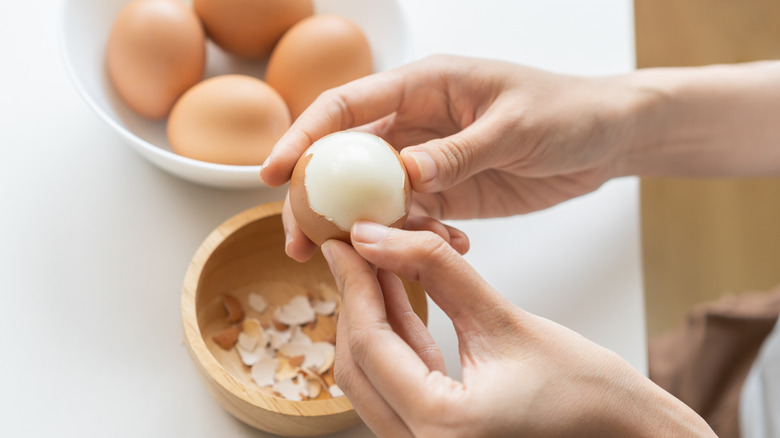
Whether hard or soft-yolked, boiled eggs are a convenient way to add protein to snack or meal time, but properly cooking and peeling these bad boys can be a challenge. Anyone who eats them regularly probably has their own nifty hacks to make boiled eggs easier to enjoy. Some might have even heard a persistent rumor that older eggs are easier to peel than fresh ones, and decided to age their eggs before boiling, just to be safe. But is there any truth behind this strange claim?
Surprisingly, yes, according to expert chef Nelson Serrano-Bahri, who serves as the director of innovation at The American Egg Board. "This is one of those kitchen tips that's rooted in real science," he confirms. What happens is that, as eggs age, their contents lose moisture and air enters through the shell. "That combination raises the pH, and causes the egg white to pull away slightly from the shell membrane, making it less likely to stick during peeling. So, the advice to use slightly aged eggs for boiling holds up," Serrano-Bahri says.
However, even if the science is sound, the difference between peeling an old egg and a young one might not be major. When Chowhound asked another expert — Rosie Kellett, author of the new cookbook "In for Dinner" — she told us she has "genuinely never noticed a difference in the age of an egg and the ease with which it peels." So for easy-to-eat eggs, it's best to keep a few more tricks up your sleeve.
More egg peeling tips
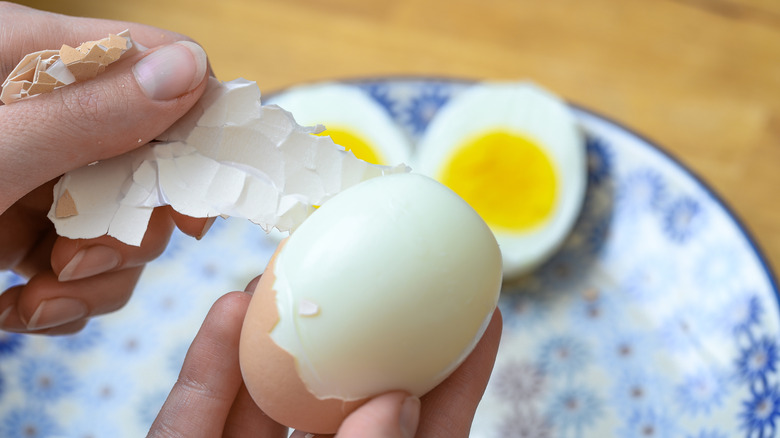
If you don't have the patience to age your eggs, or find that yours still stubbornly resist peeling, there are plenty more tricks for you to try. Rosie Kellett likes to use a version of the rolling technique on her hard-boiled eggs, which gently breaks up the shell and inner membrane without squishing its contents. First, she says, lightly crack the boiled egg against a hard surface, then roll it under your hand. "At this point you want to try and locate the air bubble, often found at the base of the egg, and begin peeling from here," she continues. "Make sure you get under the membrane and then using the side of your thumb, push the shell away — if done well it should all come off in one piece!" If working with more delicate soft-boiled eggs, use a gentler touch rather than cracking the whole shell at once, and try using a spoon for help peeling.
You've probably also heard that submerging your eggs in cold water or an ice bath after boiling is crucial to cooking them to the right temperature, but according to Nelson Serrano-Bahri, "it's also a prep step for easier peeling, by helping separate the egg from the shell." He says, "The rapid temperature drop helps contract the egg inside the shell, making peeling easier. Also, gently cracking the shell all over and peeling under running water can help slide the shell off more smoothly." This is similar to Gordon Ramsey's own hard-boiled egg peeling hack, so you know it's sound.