

Wolfgang Puck Refuses To Cook With This Salt You Likely Have In Your Pantry

We may receive a commission on purchases made from links.
Of all the exotic ingredients you're likely to find in the kitchen, from saffron, to tamarind, to cuts of offal, there's one that's more important than just about any other — and it's one that's more complicated than you might necessarily expect. Salt goes into just about everything we cook — as an effective natural flavor booster, it's an essential ingredient — so while you might dismiss the idea of buying a specific type of salt at first (it's just salt, right?) choosing the right variation of salt is actually incredibly important. So, how do you go about picking the right salt for you?
Well, for starters, it helps to know what to avoid, and according to legendary chef Wolfgang Puck, there's one type in particular that you should keep far away from your kitchen. Chances are, you've already got some iodized salt kicking around in your cupboard somewhere. Introduced in the 1920s to help combat iodine deficiency (a common problem at the time), this iodine infused salt (hence the name) has remained a pantry staple ever since. In an interview with Masterclass, Puck explained exactly why he hates the stuff: "I never use iodized salt because iodized salt is not good for you and has no flavor. Good salt has a lot of flavor." Iodized salt can also have a flat, yet subtly chemical-y aroma to it that isn't exactly ideal for enhancing the natural flavors of food. Instead, Puck reaches for natural salts, which have a lot more nuance and a cleaner salty flavor.
Why pro chefs choose to skip iodized salt
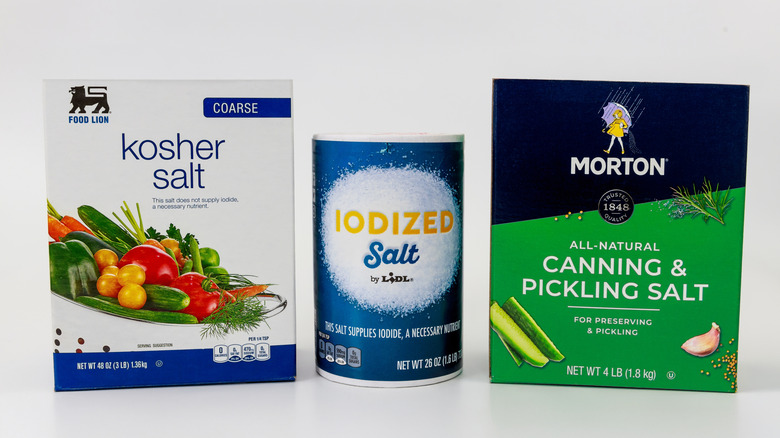
The biggest reason why pro chefs stay far away from iodized salt, preferring its natural, flakier cousins, is taste — but it isn't the only reason. Iodized salt often has a slightly bitter, metallic aftertaste (left by, no surprises here, the iodine) which can overwhelm delicate dishes or more subtle ingredients. If the goal is to really make the natural flavors of your food shine (and it should be), then you're better off with the cleaner profile of sea salt. Iodized salt also often contains anti-caking agents to keep it from, well, caking, which means yet more chemicals added into the mix.
This isn't a matter of snobbery: Rather, it's all about precision. Salt should provide a dish with depth and balance, and the texture and flavor of iodized salt makes it difficult to control the degree to which you salt your food, especially at a finer level. By contrast, the kosher salt favored by Puck (among other popular seasoning and finishing salts) has larger flakes, easily pinched for greater control. Plus, the flakes' larger, irregular structure means that they actually dissolve more evenly into your food, making for significantly more consistent results. It's a matter of tradition, too: European chefs have historically cooked with natural salts harvested from regions like Brittany, in France, which imbues its salts with trace minerals creating natural complexity and a more characterful final product.