

The Best Fish Sauce Alternative If You Don't Have Any In The Pantry
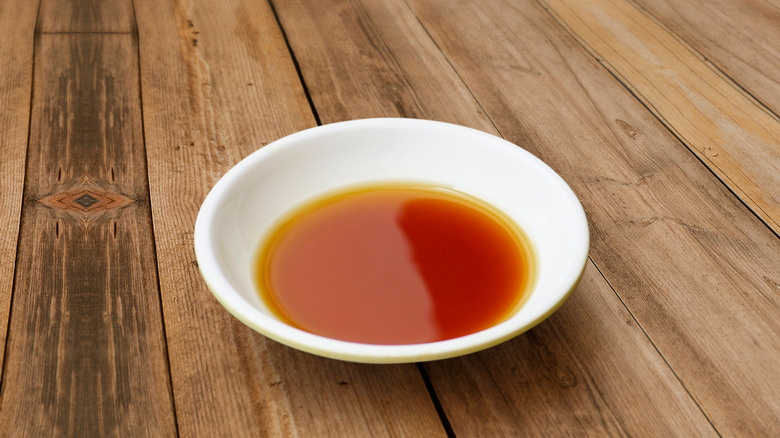
Despite being a staple ingredient for millions and a favorite of chefs since (quite literally) ancient times, fish sauce never seems to get the plaudits it deserves. Made from fermented fish, the classic sauce delivers a salty, funky depth to dishes whilst not being anywhere near as overpowering as its intense smell might suggest. A delicious and surprisingly versatile ingredient that adds immeasurable complexity to any dish with just the right balance of sweet, salty, and umami, it's one of the most useful weapons a cook can have in their arsenal. But, if you find yourself without it and in need of an umami boost, there are a couple alternatives.
To learn more, we spoke to chef Mike O'Mara, a food scientist, product developer, and culinary innovator. "Fish sauce is an incredible vehicle for delivering flavor," he told us. "It brings rich salty and umami notes to a dish. When combined with sweet, spicy, and some sour notes, it's an unstoppable ingredient." The best substitutes mimic this blend of sweetness and saltiness. Take, for example, soy sauce. O'Mara often uses it as a direct replacement: "I have used soy sauce as an alternative to fish sauce, sometimes as a direct swap to make a dish vegan friendly," he explained. "While it is not quite the same in flavor or flavor impact, soy sauce is a decent substitute that most of us have in our pantry." It's your best option if you're in a pinch, but not your only one.
Soy sauce is a great swap, but there are others

Soy sauce is a pretty good swap for fish sauce, particularly when trying to recreate that lovely, lip-smacking umami flavor. It pairs well with similar flavors, too, since the two are often used in tandem (think Thai pad kra pow or a spicy, tangy laab salad). Because of the way it's brewed, soy sauce also has a lovely subtle sweetness to it that can help you mimic the similarly sweet notes in fish sauce. Choosing the right type of soy sauce can also help you here; you might not realize it, but different soy sauces have distinct flavors. Chinese soy sauces tend to be a little sweeter than their Japanese or Korean counterparts, so they're the ones to look for if you're trying to channel the pungency of fish sauce.
It's not the only alternative you have at your disposal, though. According to Mike O'Mara, you can also use another umami-boosting powerhouse: Worcestershire sauce. It actually contains anchovies, which makes it a closer match to the flavor profile of fish sauce than you might realize. "While more complicated in flavor, Worcestershire sauce actually has fish sauce in it, along with other fun things, so it can oftentimes be used as a substitute," O'Mara explained. Both this and soy sauce can be used in a one-to-one replacement of fish sauce, making them super easy to swap in and out.
How to adjust your sauces to get the best results

Even the best stand-ins need a little tweaking to truly recapture the magic of the original. That's especially true when it comes to picking a substitute for fish sauce, which has a pretty unique blend of flavors. Mike O'Mara noted that when replacing fish sauce with soy sauce in particular, there's something that feels a little flat. Luckily, you can compensate by tweaking the rest of the dish: "I noticed when substituting fish sauce with soy sauce, some of the saltiness in particular was lacking, so upping the salt in the rest of the dish is a good way to compensate for the swap."
Importantly, he noted that it's still the best direct substitute since it's similar not only in flavor profile, but in its viscosity and coloring. However, fish sauce tends to be lighter with a transparent amber color, so your dish darkens with the use of soy sauce. Fish sauce also delivers more on the umami front, so to compensate you can add other umami boosters. Dried mushroom powder works well, for example, as do miso, yeast extract, or the old faithful, MSG.