

First Time Building A Charcuterie Board? Use This Trick To Keep It Nice And Organized
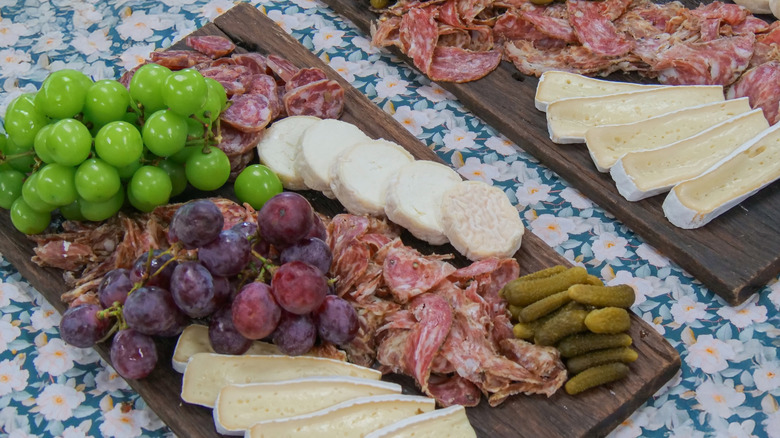
If you're a fan of the infamous "girl dinner" that went viral across social media, learning how to properly build a charcuterie board is an absolute must. While girl dinner is typically an assemblage of random foods that need very little preparation, the skills needed to make it are easily transferable. With just a touch of finessing and a little practice, you can use your keen eye for flavor pairings to build charcuterie boards that are both pleasing to the eye and delicious on the palate.
There's even an organizational trick that requires something you likely already have on hand — sticky notes. You may know that the golden rule for building perfect charcuterie boards is to place all the largest items first, using smaller containers and loose items (e.g., grapes, nuts, or olives) to fill in gaps to make your board look full and inviting. However, getting those big, beautiful bowls of hummus and plates of whole grain crackers placed "just so" can be a process, making it hard to remember where everything was between the planning stage and actually serving the board.
This is where the sticky notes come into play. Once everything is arranged to your liking, write each item or grouping of items on individual sticky notes. Remove each item one at a time, placing a sticky note in its place as you go. Then, you can store everything in the fridge to keep it fresh until about 20 minutes before it's time to serve and enjoy.
Charting your charcuterie the right way
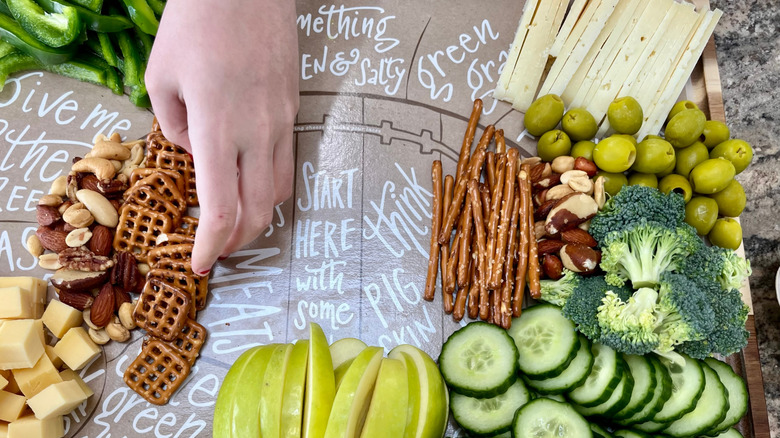
One of the biggest mistakes you can make when building charcuterie is choosing a board that's too small. It's almost always better to choose a platform bigger than you think you'll need, as it's fairly easy to hide gaps with fancy crackers or group things artfully together, leaving winding trails between foods like garden paths. This is another area where sticky notes are useful, as they can help you plan the flow of your board.
Do you want things to range from sweet to salty or from left to right? Or perhaps you'd prefer to have small amounts of more intense flavors around the edges of the board, pushing toward larger portions of more universally enjoyed flavors in the center. Sticky notes are easy to reposition, meaning you can test out different arrangements until you find one you like. You can even stick them to containers you plan to use before filling them to ensure that they'll all fit easily on the board and that they share an aesthetic.
Since sticky notes come in hundreds of colors, they're also easy to color code for different areas of the board, or for different boards altogether. Perhaps you have one board loaded with universally appealing nut-free, lactose-free, vegan charcuterie options, while the other is a festival of prosciutto, smoked gouda, and spiced almonds. Using bright green notes for the vegan board and hot pink ones for the meat-inclusive one prevents mix-ups, so everyone can enjoy themselves safely.