

Are Special Crêpe Pans Really Necessary, Or Can You Get Perfect Crêpes Without One?
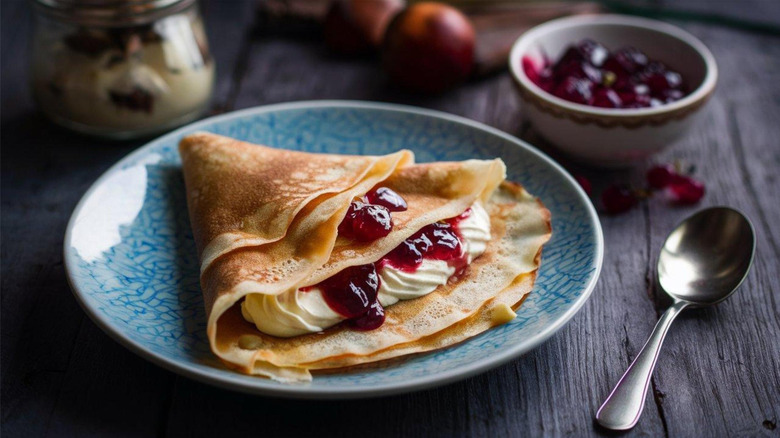
Crêpes are one of those foods that seem much fancier and more complicated to make than they actually are. While crêpes are different from pancakes in that they're thinner and a bit more versatile than one of America's favorite breakfast foods, they share similar ingredients and may be served with similar accompaniments. In fact, it's not uncommon for crêpes to be center stage on National Pancake Day — a fun, casual holiday observed on February 28 in the United States. This event also often jumpstarts the annual debate over whether or not a crêpe pan is truly necessary for making thin, crisp, delicious crêpes.
The main difference between a crêpe pan and a standard nonstick skillet is how flat a crêpe pan is on the bottom. Whereas some skillets gently curve upward into the sides, the bottom and sides of a crêpe pan are bracketed by a sharp corner. They also tend to be very shallow compared to skillets — about ½ an inch deep, or less. These differences are supposed to help the crêpe spread and cook evenly over the whole bottom of the pan, developing the classic crisp edges from a more even heat distribution.
However, that doesn't mean you need to rush out and purchase a new kitchen tool to try your hand at making some savory buckwheat crêpes stuffed with salmon and homemade créme fraîche. A sturdy nonstick skillet is just as capable of turning out thin, crisp crêpes, though they may be a touch smaller and less uniform.
Crêpe pan pros and cons
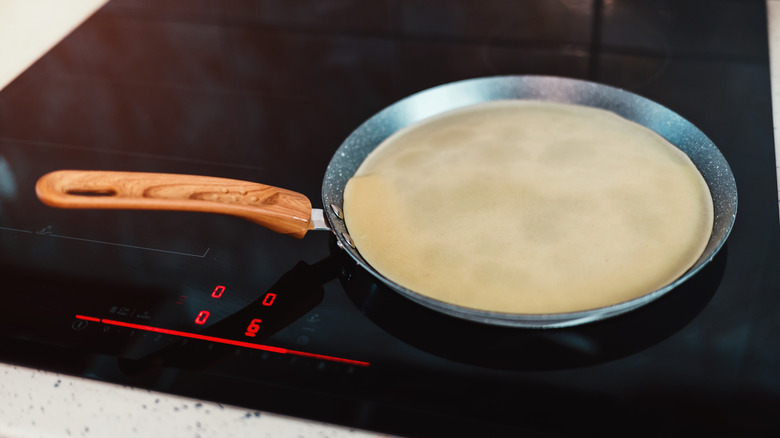
Obviously, the biggest advantage to owning a crêpe pan is that it's designed to make perfect, delicious crêpes. Many of them are also designed to be light enough to use the swirl method to distribute the batter rather than using the wooden rateau (a T-shaped tool for spreading crêpe batter). This makes the process a bit more fun in addition to being more foolproof than attempting to use a regular nonstick pan.
Additionally, a crêpe pan isn't a one-trick pony. Since it's designed to cook flat, thin layers of food you can also use it to make oversized pancakes, portable Korean omelets wrapped in rice paper, and thin crust pizza. Pretty much anything that requires evenly distributed heat and a large, flat surface is perfect for making in a crêpe pan. Just be sure to avoid making overly greasy or sticky things inside it, as these may damage the nonstick coating and render your pan useless. The same goes for metal utensils — keep them away from your crepe pan.
Of course, all of these factors are also true for ordinary 9-inch nonstick skillets, which frequently come standard with kitchenware sets, meaning most people already have one in their arsenal. If your current pan set is older and you're looking to upgrade, or you're building one for the first time, it may be worth it to add a crêpe pan to the mix. Otherwise, this is one specialty kitchen tool you can almost certainly live without.