

The Controversial French Delicacy You Might Want To Avoid Ordering If You See It On A Menu
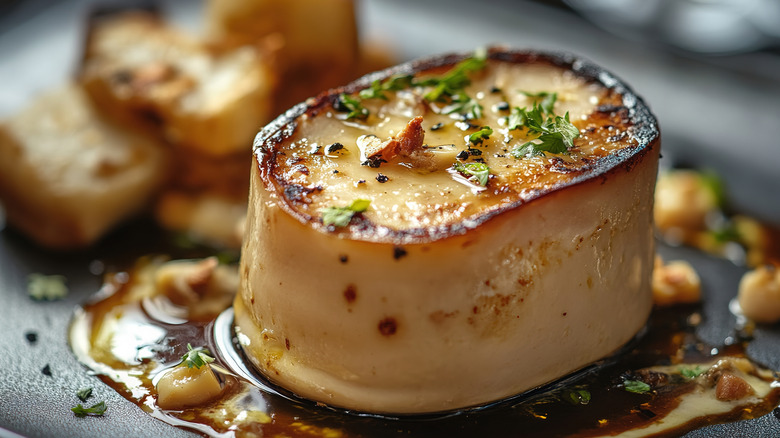
From caviar to shark fin soup, there are numerous delicacies eaten around the world that are prized for being both rare and delicious. However, animal welfare organizations contend that a number of these gourmet, expensive foods raise ecological and ethical concerns like overfishing, poaching for shock value foods, and animal cruelty. Arguably one of the most controversial delicacies hailing originally from France is foie gras, or fatty liver from ducks or geese.
Foie gras is prized for its luxurious, buttery taste and creamy texture. It can be seared like a steak or made into a pâté and spread on crackers. Foie gras has a long history, dating back to ancient Egypt. While hunting geese and ducks, Egyptians observed that the birds binge food before migrating to store up extra calories for their trip. The extra food adds fat to their liver causing it to increase in size, and presumably, in flavor. The ancient civilization made use of this and began force-feeding geese to replicate the natural occurrence.
Foie gras grew in popularity in 16th century Europe, particularly in France. Today, close to 80% of foie gras in the world is produced in France, specifically in the Dordogne Valley. However, many people and organizations stand on the belief that the process used to produce foie gras is inhumane since it involves force-feeding animals. Several countries, including Germany and the United Kingdom, as well as the state of California, have even banned force-feeding and foie gras production.
The force-feeding process
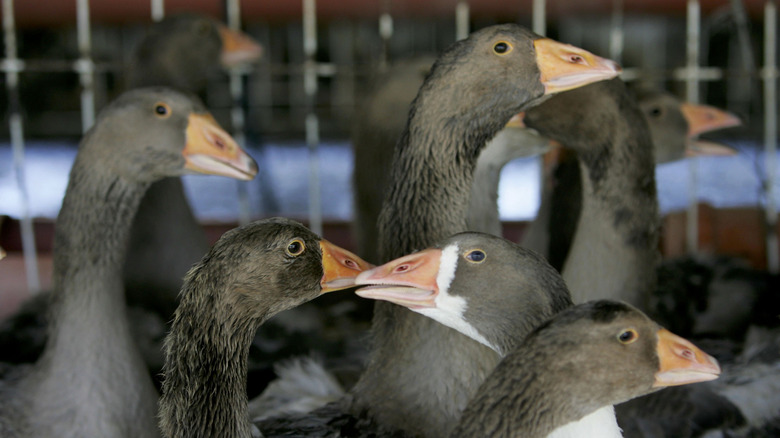
Force-feeding ducks and geese for the production of foie gras is a process called "gavage." It involves manually inserting tubes into the waterfowl's esophagus and feeding them a grain mixture, typically two to three times per day, causing their liver to swell immensely. Mainly male ducks are used to produce foie gras since they are typically larger than females.
Animal rights advocates assert that the force-feedings cause pain, injury, and stress to ducks, as well as a higher mortality rate than non-force-fed ducks. According to PETA, in an investigation of Hudson Valley Foie Gras in New York, they found that each worker would force-feed up to 500 ducks each day, leading to improper treatment and mishandling that sometimes resulted in ducks' ruptured organs. At a farm in Montreal, PETA discovered ducks kept in iron cages that prevent them from standing or spreading their wings to make force-feedings easier.
Of course, there are two sides to every argument. Some culinary experts maintain that the production of foie gras is not so controversial, arguing that, just like chicken and cattle farms, there are bad ones and good ones and the ethical decision lies in choosing the right farm. The "good" farms use gentle, flexible tubing, limit workers to just a few ducks to feed, and allow the ducks plenty of space to roam. However, one might argue that determining the source and humane production (if it exists) of the foie gras you order at a restaurant is near impossible.