

Remove Broken Shells From Cracked Eggs Quickly With This Water Hack
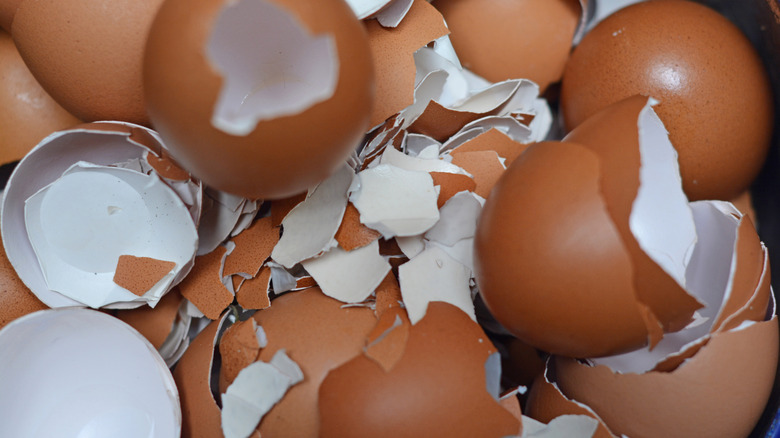
We all wish we were as cool as those Instagram chefs who can flawlessly crack an egg with one hand, not dropping a single shell in the process. But if you haven't learned the trick yet — and typically end up with a smattering of unwanted shells in your scrambled eggs — this hack is for you. Once the shells are in, all hope is not lost: Simply dip your finger in water, and the shell will stick to your finger for easy removal.
The reason these shells are so slippery is because of the egg whites that coat them. They're made of about 90% water and 10% protein, and they form a thin layer that makes picking up a shell piece with dry fingers feel a little like trying to grasp a bar of soap. But egg whites don't stick to water very well because their hydrophobic proteins cluster on top, away from the water inside them, so a quick dip helps your fingers cut through the slime and get good traction to pull any shell shards to safety.
Keeping your scrambled eggs crunch-free — and bacteria-free

For peak efficiency, the water-dipping method is honestly your best bet. But by sticking your fingers into your food, you do run the risk of introducing bacteria into your scrambled eggs. Food safety is important for eggs to ensure you don't contract salmonella or other food-borne illnesses, so if this shell-snatching technique feels a little too risky for you, there is another method you could try. The most creative? Using another shell fragment to pick up the offending piece. Unlike the other process, this works because the sharp shell cuts through the egg white, allowing you to scoop out the fallen shell better than you would be able to with your dry fingers or even a spoon.
Of course, avoiding broken eggshells altogether is even better, so here's the best advice we can give you: Rather than using the edge of a bowl to crack your eggs, use a flat surface like a countertop or cutting board. And if you've simply accepted that you're clumsy, at least crack each egg into a ramekin or glass bowl before pouring it into your pan — whether with your finger or an extra shell bit, no one wants to reach into a hot frying pan to fish out a shell, so you might as well do it before you really get cooking.