

The Rise And Fall Of The Old School Carnegie Deli In NYC
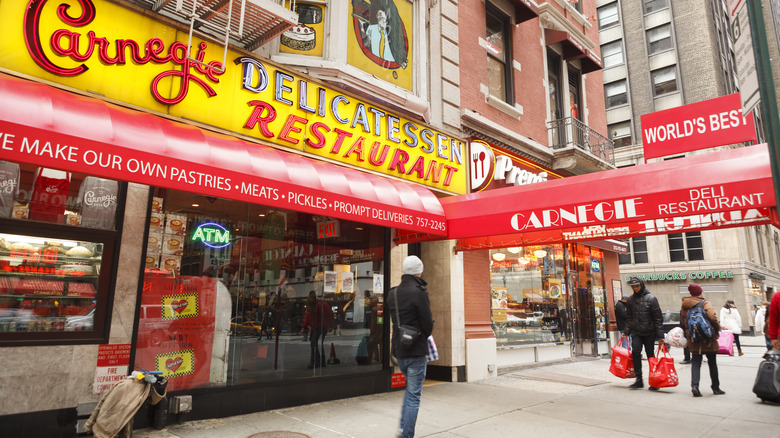
It's right up there with the 21 Club, the Four Seasons, and Lutèce — all venerable New York City restaurants New Yorkers both loved and took for granted, thinking they'd always be there. But when the Carnegie Deli piled the pastrami onto two slices of rye for the last time in 2016, after nearly 80 years in business, New Yorkers shed a collective tear. Marian Harper Levine, who had taken over the business from her father, Milton, found the long restaurant hours a strain. The restaurant had also been plagued by a wage dispute, Levine's messy divorce from her husband, and an illegal gas hookup that closed the restaurant for nine months in the year before it closed.
The Carnegie Deli originally opened as a 40-seat restaurant owned by Izzie and Ida Ordel in 1937. Located on Seventh Avenue between West 54th and 55th Streets, the deli took its name from Carnegie Hall, which was just two blocks to the north. It's no surprise that its clientele consisted of performers and musicians who came before and after their concerts. Just five years later, the Ordels sold the business to Max Hudes, who started catering to celebrities appearing on the Ed Sullivan, Sid Caesar, and Jackie Gleason shows (the Ed Sullivan Theater, now the home of The Late Show with Stephen Colbert, is still located one block south from where the Carnegie Deli stood) and bands staying at nearby hotels.
Hitting its stride after being named tops by Mimi Sheraton
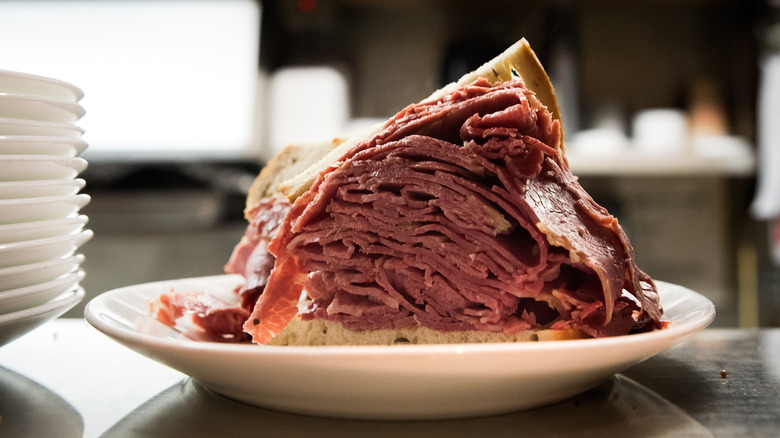
Many believe the restaurant truly hit its stride after 1976 when Milton Parker and Leo Steiner purchased the restaurant. The two men did things a little differently than the previous owners — and also than the other popular New York City delicatessens. For one, the restaurant certainly knew how to upgrade its corned beef. With Steiner's brother Sam in charge, the corned beef, along with pastrami and tongue, was prepared in the deli's basement using a proprietary pickling liquid and a hand-pumped brine machine. At the time, most other restaurants purchased their meat wholesale. The meat was cured and pickled for a week to 10 days and sliced and served hot to customers.
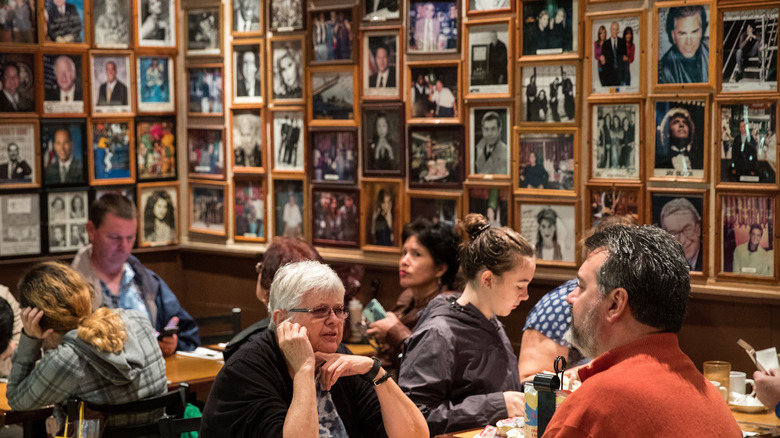
But what really helped the Carnegie Deli become a destination for New Yorkers and tourists alike was a 1979 review by then New York Times restaurant critic Mimi Sheraton, who named the Carnegie Deli — along with The Pastrami King and Bernstein on Essex Street — the "tops" among New York City's delicatessens. Soon the restaurant started regularly attracting celebrities and began lining its walls with photographs of those who had visited. The restaurant was also immortalized in Woody Allen's film "Broadway Danny Rose" and was said to have named a sandwich after the titular character.
You can still get a little of the Carnegie Deli experience
The restaurant was revived for two brief moments — both to commemorate the launch of a new season of "The Marvelous Mrs. Maisel," the Amazon Prime television show about a 1950s housewife-turned-comic featuring Rachel Brosnahan. To celebrate the start of the show's second season, Amazon fully recreated the restaurant in a new location downtown, even offering sandwiches at 1950s prices. For the third season, Amazon gave sandwiches and cookies out free from a Carnegie-branded food truck.
There are several other ways to recreate the Carnegie Deli experience. Even though restaurants located in casinos in Bethlehem, Pennsylvania, and Las Vegas have also closed, the company still operates two concession stands in Madison Square Garden. People can also purchase Carnegie Deli meats on the company's direct-to-consumer website. The company also launched a pastrami and corned beef combo pack available exclusively at Costco.
The Carnegie still has its legions of fans. Although Anthony Bourdain thought the best pastrami in New York City came from Katz's, on the Lower East Side of Manhattan, had the Carnegie Deli still been open in 2024, it likely would have made it to our list of must-visit delis in America.