

Gordon Ramsay Rarely Cooks Steak On The Grill (And We Can Honestly See Why)

Some celebrity chefs are famous for just being celebrities, while others have become famous because, well, they actually know how to cook world-class food. That's certainly the case with Gordon Ramsay, who currently holds seven Michelin stars across his restaurant empire. So when chef Ramsay cooks, he's certainly worth watching. On that note, one thing we've noticed watching Ramsay cook over the years is how he cooks steak. Rarely do you see him cook steak on a grill. It's almost always in a pan. There's a reason for that because pan-searing steaks has several advantages, namely the Maillard reaction.
This chemical process was originally discovered by French chemist Louis-Camille Maillard in 1912. In the most basic terms, the Maillard reaction gives meat a crispy, brown crust. In the case of steak, it's what makes a steak seared in a super-hot pan so flavorful. With a grill, you can create nice cross-hatch grill marks on your juicy ribeye — but, cooked in a pan, you're basically creating a single "grill mark" across the entire surface of the steak. When done right, it's an absolute flavor bomb.
A hot pan can add a nice crust to any protein
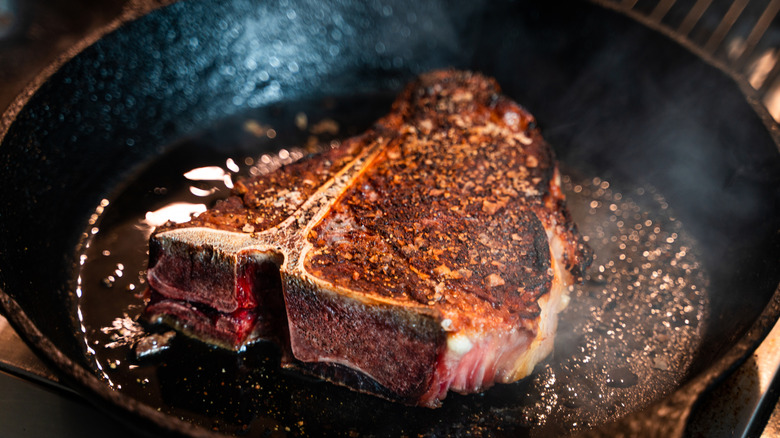
If you watch his videos, you'll see that Gordon Ramsay cooks most of his proteins in a pan. Even when he cooks outside, it's usually with a pan over live fire. That's because the same Maillard reaction principles apply to chicken, certain skin-on fish, lamb, and other proteins. The pan caramelizes and browns the entire surface area of the protein, giving you a similar tasty exterior to a ribeye or New York strip — with less fattiness, most likely.
To create a properly seared steak, you'll want to thoroughly season the meat on all sides to produce a nice crust. Ramsay uses a two-part oil trick for the crispiest crust, and you'll want to use an oil with a higher smoke point, such as avocado oil, so it doesn't burn in the pan. Place the steak inside, and let the pan do its work. Just like with the seasoning, be sure to sear all sides of the steak, not just the top and bottom. For fattier cuts like ribeye, you want to ensure that the fat renders completely, so even letting the steak stand on its side is ideal.
To achieve the same results on a grill, place an oven-proof pan (such as a cast iron) inside a closed grill and turn it on high. Heat the pan inside the grill, add the oil, and you're off. Cook to your preferred doneness, and let the steak rest for a few minutes before serving. This will keep the juices locked in and create a fatty, flavorful bite.