

The Popular Olive Oil Brand That's Mostly Owned By A Chinese Company
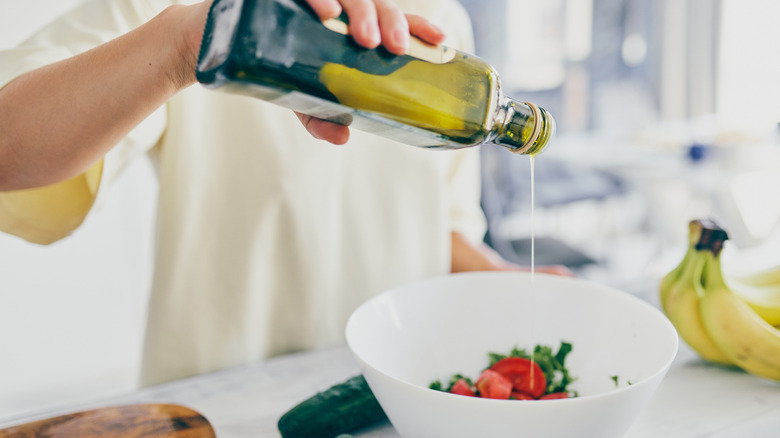
Have you have ever drizzled a golden stream of Filippo Berio, the popular store-bought olive oil brand, over a Caprese salad and basked in its authentic Italian taste? Well, here's a curveball: the brand is now mostly owned by a Chinese company. That's right. Your Mediterranean pantry staple has roots stretching far beyond the rolling hills of Tuscany and straight into a corporate boardroom in China!
The company behind Filippo Berio, Salov Group, sold a majority stake back in 2014 to the Bright Food, a state-owned Chinese giant with holdings that span everything from dairy to wine. What this means is that while the label on your bottle still shouts "Lucca, Italy," the profits mostly flow eastward. And it's not just some obscure corporate footnote — it's part of a bigger, fascinating shift. As demand for high-quality olive oil grows globally, brands with European heritage are increasingly being scooped up by international buyers.
For loyal home cooks, this raises the big question: does it matter who owns the brand, as long as the oil inside stays the same? The short answer is no, not really. Filippo Berio's production still happens in Italy, with its signature blends sourced from groves across the Mediterranean. But the story of how an Italian kitchen icon landed in Chinese hands is worth chewing on, because it tells us a lot about how the global food trade works today.
A global pantry in your bottle
Filippo Berio's Chinese ownership is part of a larger pattern you will spot in your grocery aisle if you look closely. Beloved Western food and drink labels often belong to holding companies headquartered halfway across the world. Think Smithfield pork (Chinese-owned), Corona beer (Belgian-owned), or Häagen-Dazs (currently under U.S. corporate control, despite its faux-Danish name). The Italian olive oil on your counter is simply one more example of this tangled global pantry.
The case of Filippo Berio is specifically interesting because the brand has built its reputation on tradition. Founded in the 1800s, it leaned heavily on the image of rustic Italian authenticity. That story still sells, even if the company's shareholders now have a Shanghai zip code. And it's not just clever branding — Italy remains a key hub for bottling and blending, ensuring quality stays consistent. In other words, while the company's ownership changed, the product's DNA didn't suddenly switch to some vegetable oil.
For everyday cooks, there's no need to panic. Your olive oil vinaigrette isn't compromised. If anything, Bright Food's investment signals that olive oil has become a truly global commodity, valued far beyond Italy's borders. If you want to keep things extra authentic, you can always hunt down single-estate olive oils from small producers. But for most of us, that green Filippo Berio bottle is still a trustworthy workhorse that finds a way to get restocked in the kitchen pantry.