

The Michelin-Approved Secret To Next-Level Pancakes
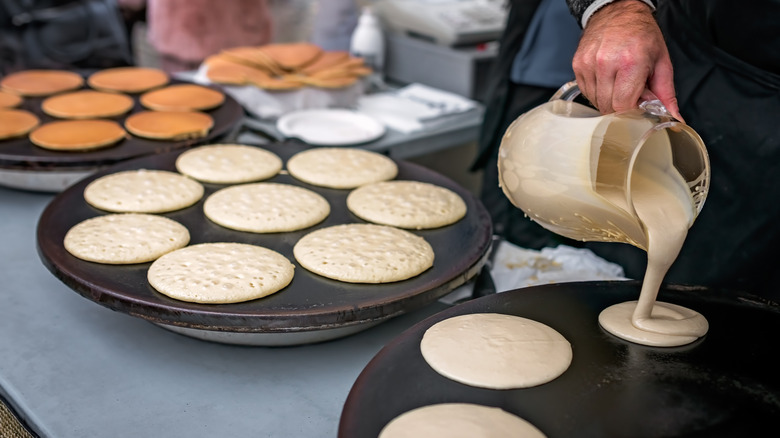
Basic buttermilk pancakes are a breakfast favorite that feel like a hug on a plate. Even though there are many mistakes you can make with pancakes, it's a hard food to hate. While you might be used to making pancakes with baking powder, adding a little yeast to your batter will turn your morning flapjacks into something truly special.
Essentially, yeast gives the pancakes larger pockets of air, resulting in a fluffier and lighter pancake than traditional recipes. This technique is used by Golden Diner in New York City, whose pancakes went viral on social media. The chef, Sam Yoo, trained at the now-closed two-Michelin-star Momofuku Ko, where he developed his skills that led to the recipe that brought simple pancakes to restaurant-level quality.
To try making these yourself, start by making a pre-ferment with yeast, warm buttermilk, and flour, then let it sit for an hour to let it develop both flavor and rise. As you let it rest, grab two separate bowls and whisk together the remaining pancake ingredients, separated by wet and dry ingredients. Combine the pre-ferment with the wet mixture. Once combined, you will want to gently fold in the dry ingredients until smooth. With your batter made, cook your pancakes on a warm skillet. Once they cook to that lovely golden brown, plate and serve immediately with butter and or syrup.
Experimenting with the yeast pancakes
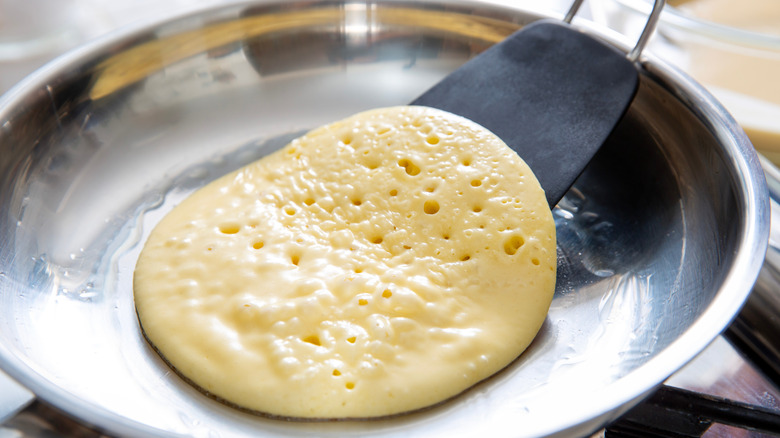
A nice feature that comes with these yeast pancakes is their flexibility and forgiveness. Moreover, you can tweak the ratio of ingredients to make them exactly how you want. A good first step to take when experimenting is to use one part eggs, one part milk, and slightly more flour. This will result in a thicker batter that will hold its shape and allow the yeast to create air pockets. As you experiment with different ratios of ingredients, you'll start to understand how small adjustments can change the texture and make the process feel more like an art than a science project.
Remember that resting the batter is essential to maximizing the fluffiness of your pancakes, which can be as little as 15 minutes or as long as eight hours overnight. Play around and see what you like. After all, this will give the yeast time to activate and improve the rise while also developing subtle flavor notes that baking powder alone cannot achieve. Although this is a step that you might be eager to skip, the wait is what sets these pancakes apart from your usual breakfast.
Once the allotted time has passed, your batter is ready. You can fold in your favorite extras like chocolate chips and berries without deflating the mix. Yeast pancakes are simple to make, and with just a bit of patience, you can recreate the taste of a busy New York diner right at home. For those of you who want something a bit healthier, all you need are three ingredients for hearty oatmeal pancakes.